Author Archives for FoodieWineLover - Gina (Martino) Zarcadoolas

Unknown's avatar

About FoodieWineLover - Gina (Martino) Zarcadoolas

My name is Gina (Martino) Zarcadoolas and I am the name behind the blog Foodiewinelover. I am of Italian and Middle Eastern descent, but spent part of my early childhood in Haiti. It's a small country in the Caribbean (formerly known as Hispanola, because the island was occupied by Haiti and the Dominican Republic before both nations became independent.) I am married to a Greek and I currently live in South Florida, where there is a big Cuban influence. As you can see, I am multi-cultural, and I enjoy traditional and authentic dishes from various cuisines. I am a passionate food writer, a recipe developer, and a cookbook author. I am a Level 2 sommelier, and recently received a level 2 "WSET: Wine, Spirit, Education, Trust". I am a culinary personality and a world traveler. In March 2023, I was awarded the title of "Italian Wine Scholar", after undergoing rigorous studies of all the twenty Italian wine regions. In between blogging, I sell and invest in Real Estate. I have been inspired by many different cuisines during my travels abroad, and I am fascinated, the way food plays a major role in cultures all over the globe. I have had the pleasure to visit many countries and cities in my lifetime, and savored many delicious ethnic cuisines. I am really excited to discover WordPress and share with you my passion for food, wine and travels around the world. I feel blessed to have visited so many places such as Puerto Rico, Dominican Republic, Haiti (where I lived), Mexico City, Taxco, Acapulco, and Cancun in Mexico; Nassau, Paradise Island, in the Bahamas; St. John, St.Thomas, San Jose, Guanacaste in Costa Rica; Rome, Naples, Capri, Positano, Florence, Venice, Lake Como, Milan, in Italy; Lugano, Switzerland; Athens, Mykonos, Santorini, Rhodes, in Greece; Kusadasi and Ephesus in Turkey; Corsica, Monacoville and Montecarlo in Monaco; Nice, Cannes in France; Barcelona in Spain and Palma De Majorca. Most recently, I visited Cartagena, Colombia. I currently live in the USA with my beautiful family. In 2013 I visited wine country, Sonoma and Napa Valley, and had the time of my life. In 2017, I explored the world of Tuscan living and wines from that region. I also visited Positano, the Amalfi Coast and Naples where I relished on some authentic Southern Italian Cuisine. I cook passionately, and I love to entertain family and friends, while sipping on some amazing wine. I will share with you some of my delicious culinary creations, and some beautiful pictures that I captured during my travels. I hope you will sit back, relax and enjoy My Food, Wine & Travel Lifestyles.

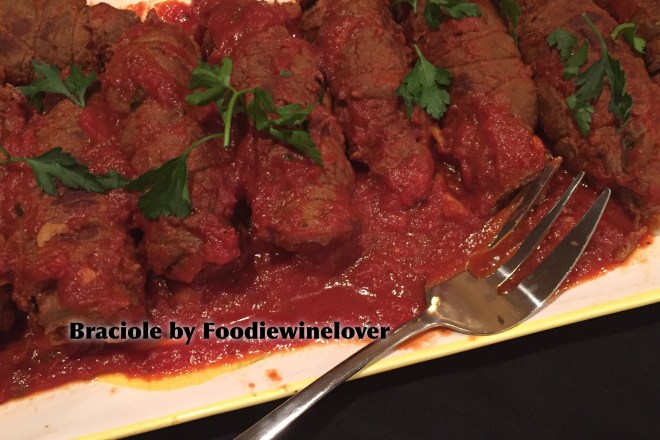
Braciole, A Gourmet Italian meat, in Tomato Sauce

It’s the holiday season, and Christmas is literally around the corner. I am hosting Christmas Day, and need to work on a menu, and finish my shopping. This time of the year is overwhelming for me, but there is a joyous feeling in the air, that goes with the madness of the season. I recently made a dish called:  Braciole, pronounced brajole, or brashole, and is the plural for braciola. It is considered a thinly sliced of meat, stuffed with garlic, parsley, and salami or prosciutto. Most grocery stores have it pre-sliced, or you can have the butcher slice it for you. Some people use flank steak, but I always use top round.  In Italy, this dish is called involtini, and the stuffing/filling can vary depending on the region. If you are still wondering what to make for Christmas, or your holiday dinner, this is the perfect and festive dish for you. It is a bit time-consuming, but the good news is, you can make it 1 or 2 days ahead of time. Please keep in mind, some people do not consume red meat, be sure to have chicken, fish and veggies grace your holiday table.

Serves: 9-12 for a seat-down dinner or 10-15 for buffet style dinner, served with other food.  Level of difficulty: Medium-difficult  Time from start to finish: 2.5 – 3 hours, depending how fast you do all your  prepping.

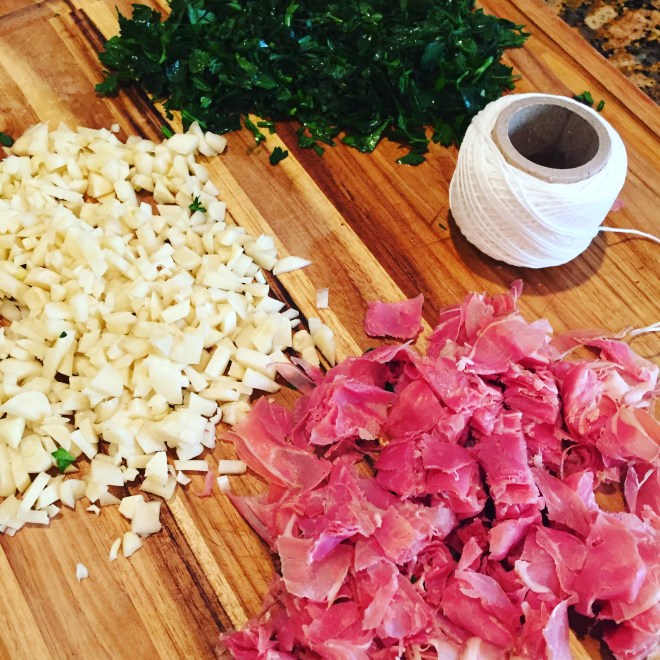
Making Braciole

Making Braciole

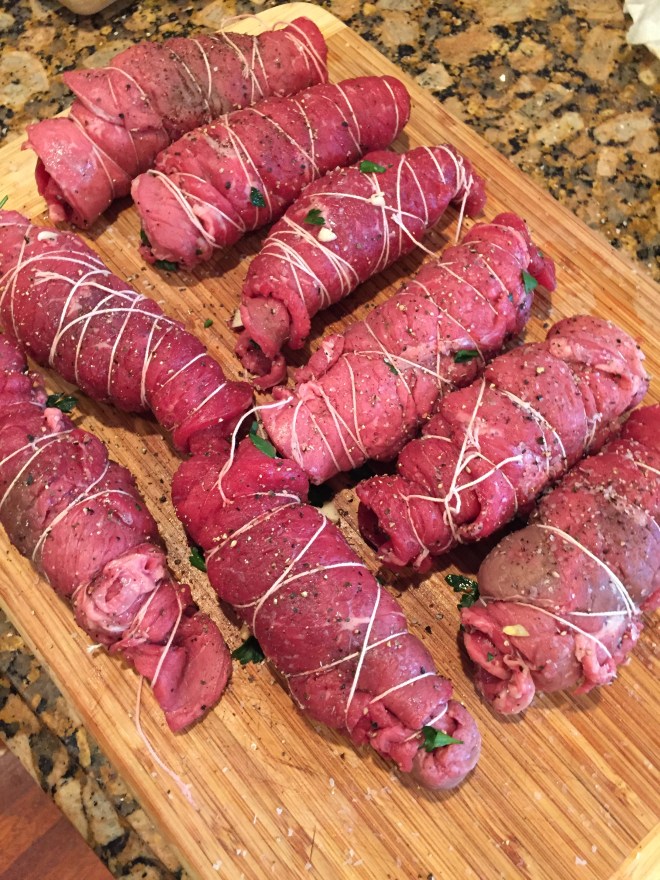
Stuffing braciole

Stuffing braciole

Braciole by Foodiewinelover

Braciole by Foodiewinelover

Searing the braciole

Searing the braciole

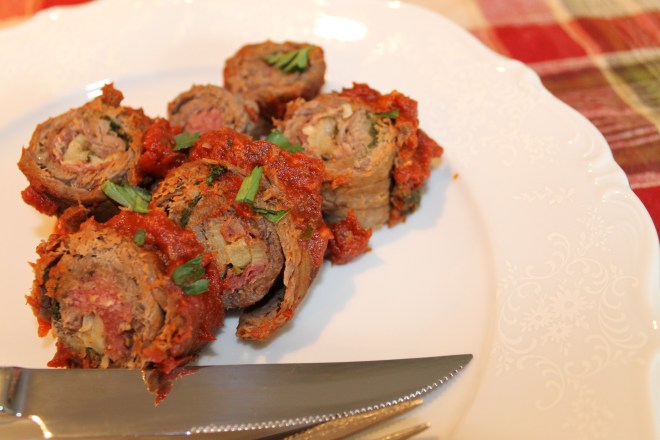
Braciole in tomato sauce by Foodiewinelover

Braciole in tomato sauce by Foodiewinelover

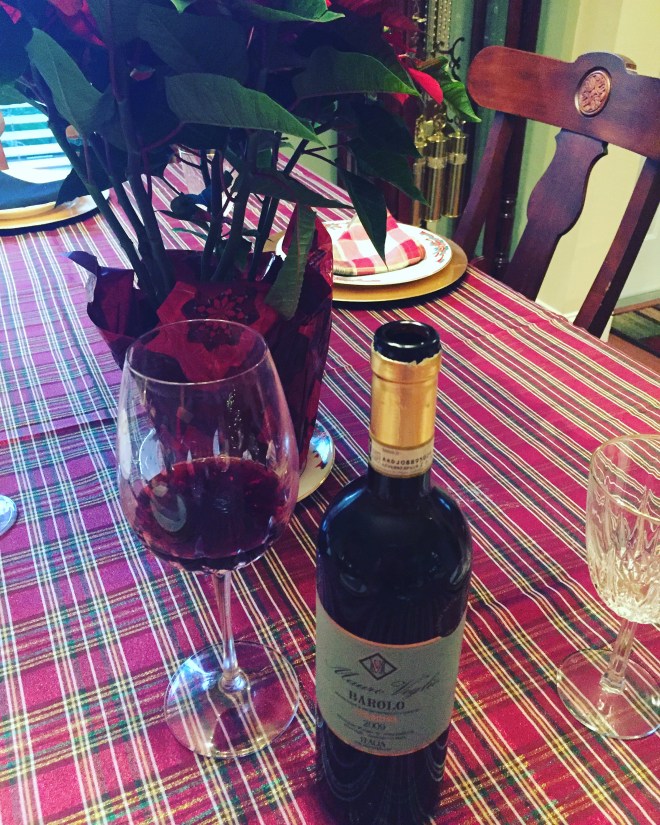
Braciole paired magically with Barolo

Braciole paired magically with Barolo


Ingredients for the meat:

  • Olive oil for pan frying
  • 3 lbs. top round steak, thinly sliced
  • 1 – 6 oz  jar of peeled garlic, chopped *
  • one large bunch of flat-leave parsley, chopped
  • 1/3 lb. prosciutto, roughly chopped
  • Sea salt
  • Freshly ground pepper *
  • Butcher twine *

    Preparation for the meat:
     

    1) Place the meat on a butcher block, season with salt and pepper to taste. Sprinkle the seasonings lightly, depending on your sodium diet, on both sides of meat. Keep in mind, the prosciutto is salty. I recommend you use less than more. You can always add more later, but if it’s over salted, the food will be ruined.  It’s hard for me to give you measurements, since I use my fingers to sprinkle the seasonings.
    2) Next, with the tip of your fingers, grab some garlic, parsley, and prosciutto, one at a time, and place at the end of the meat, as shown on the picture. Roll it, like a jelly roll, and repeat the same process. You will work an assembly line, and use the butcher twine later.
    3) Once, your meats are rolled up, it’s time to tie them up with the butcher twine, by securing both ends.  There may be some leftovers, garlic, parsley, and prosciutto. Save to use in the sauce.
    4) In a large pot, on medium high heat, heat up olive oil, Sear the meat on both sides to obtain a nice brown color, about 5-7 minutes. Do this in batches, and set aside.

    Ingredients for the sauce:

  • 1-2 tbsp. olive oil, if necessary
  • 1 tbsp. tomato paste
  • 1 container Pomi, chopped tomatoes
  • 1 container Pomi, strained tomatoes
  • 1 large jar of Mids, prepared tomato sauce, meatless*
  • 1/4 cup of water, put in jar and shake it to get all the sauce
  • Salt & pepper to taste
  • pinch of sugar, optional

    Preparation for the sauce:

    Using the same pot, add more oil, if necessary, brown the tomato paste, add all the tomatoes, water, leftover fillings, salt & pepper, sugar, and put the meat in the sauce. Bring to a boil, simmer on low heat for about 2 hours, uncovered, until the meat is tender. Stir occasionally, to make sure the pot doesn’t burn on the bottom.  If you feel the sauce is too thick, add very little water, and continue cooking.

    Pasta
    1) 2 lbs. of Rigatoni, or any pasta shape of your choice.
    2) While the sauce is simmering, bring water to a boil for pasta. Add salt, and cook as per package directions, or al dente, to the bite.
    3) Drain pasta, drizzle with olive and some sauce to prevent clumping. Set aside. The sauce should be done, and the meat tender by this time.
    4)Remove the braciole from the sauce, and use a pair of shears to cut the twines. (You will need some patience, while I was doing this, my guests were having their salad.)  Arrange them in a nice rectangle platter. This presentation is ideal for a seat-down dinner party like I had.  Serve with the pasta. However for a buffet-style, or for a holiday table, slice them, and arrange them on a beautiful platter. It is more decorative, and appealing.

Braciole

Cook’s notes:

1) Some people use toothpicks to secure the meat, but I prefer using the twine.

2) Freshly ground pepper goes so nicely with the meat.

3) If you don’t want to use garlic from the jar, go ahead and use fresh, just allow more time for peeling.  Nothing wrong with fresh ingredients, I actually encourage it, whenever possible.

4) Some recipes add cheese to the filling, but, I prefer grated  Parmigiano Reggiano, (parmesan cheese), on top of the pasta.

5) This recipe yields 9 meat rolls, but, some people shared one. There were leftovers, and, it was even better the next day.

6) For a small dinner gathering, I recommend you ask your guests if they consume meat or shellfish. Let’s not forget about gluten-free pasta for those who cannot have regular pasta. This may create extra work, but if you are having guests, it’s important to accommodate their diet, and ensure they enjoy their meal.

Wine pairing suggestions: My lovely aunt and  cousin were visiting from abroad, I decided to go all out. I paired this delectable dish with a Barolo, the king of Italian wines. The pairing was magical, and everyone was pleased with my culinary creation. You can also pair this dish with a Malbec or Cabernet Sauvignon of your choice. You want a big wine to stand up to the meat.

Buon Appetito!

Recipe by Gina for Foodiewinelover
Images by Gina for Foodiewinelover
Wine pairing suggestions by Gina for Foodiewinelover

This will probably be my last post before Christmas, therefore, I would like to wish all of you, a happy holiday season, and a Merry Christmas from my home to yours.

In closing, I would like to share this quote: “Christmas! The very word brings joy to our hearts. No matter how we may dread the rush, the long Christmas lists for gifts and cards to be bought and given–when Christmas Day comes there is still the same warm feeling we had as children, the same warmth that enfolds our hearts and our homes.”

Gina, Foodiewinelover
My Food, Wine & Travel Lifestyles


Fattoush Salad, A Lebanese Delight

Recently, my hubby and I were heading to Aventura mall, to celebrate his birthday. We missed the exit, made a u-turn, and ended up at  Gulfstream Park instead. We stumbled upon this Lebanese restaurant called Mijana.  We ordered an assortment of mezze, (or meze) that are small dishes, or plates in Middle Eastern cuisine. It’s spelled differently, depending on the region of the world.  We had their luscious, and traditional Lebanese Fattoush salad. It is considered a peasant salad, made with fresh greens, veggies, toasted pita bread, and a lemony dressing. We could not get enough of the intense flavors, and the freshness of the salad. I knew, it wasn’t going to be long, before I attempted to make it in my kitchen. You will need a spice called Sumac, that is tart and full of flavors.

Serves: 4 as a side dish  Level of difficulty: Easy

Ingredients:

  • 5 ounces of romaine lettuce, chopped
  • 5 radishes, sliced
  • 1 handful of cherry tomatoes
  • 1/2 of an English cucumber, sliced * (Do not peel)
  • 2 scallions, chopped
  • 1/4 cup fresh Italian parsley, chopped
  • 1/4 cup fresh mint, chopped
  •  2 small pita bread, cut up in squares, broiled


Dressing:

  • 1/2 lemon, juiced
  • 4 tbsp. extra-virgin olive oil, + more for pita
  • 1/4 tsp. sumac + more to sprinkle
  • 1/2 teaspoon sea salt
  • freshly ground pepper

Preparation:

  1. Arrange the lettuce, radishes, tomatoes, cucumber, scallions, parsley, mint in a large bowl. Set aside.
  2. Cut pita bread in small squares, place on a tray, and drizzle with olive oil. Broil for about 3 minutes. Make sure you don’t burn them. Remove them.  Place on top of the salad.
  3. Whisk  lemon juice, olive oil, sumac, salt & pepper until blended.
  4. Pour over the salad. Toss well. Sprinkle more sumac to garnish, and drizzle more olive oil, if necessary.  Serve with a piece of chicken or fish, for a delicious and nutritious meal.

Fattoush SaladI hope you will try this refreshing salad, and share your experience with us.

Lebanese food

Lebanese food at Mijana Restaurant


Tips: 1) English cucumbers are generally long, with fewer seeds, and the skin is tender. If you don’t have this kind, the regular cucumber will do the job.
2) Some authentic recipes call for pomegranate molasses, but I didn’t have it on hand.  Purslane, a nutritious weed, can also be used, but not easily found in my area.

Happy Tossing!

Gina, Foodiewinelover
My food, wine, & Travel Lifestyles

Recipe inspired by Mijana restaurant, made in my kitchen
Pictures by Gina for Foodiewinelover


Back To My Roots, A Delicious Greek Cookbook

Back To My Roots
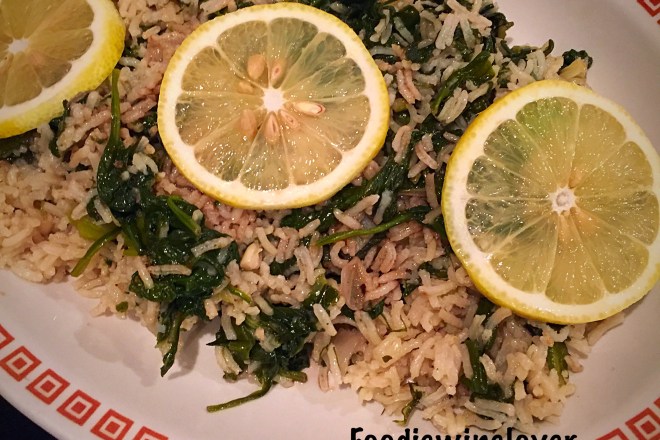
Krystina Kalapothakos is a chef with a Greek soul, as she puts it. She blogs over at Kouzounas Kitchen.  Kouzouna is her grandmother’s maiden name, and not to be confused with Kouzina, which means kitchen in Greek. I met her online a little over a year ago, via a Twitter friend.  She is the founder of a wonderful group on Facebook called: Foodify.  We follow each other on social media, and share each other’s recipes with our audience.  Krystina is inspired by her yiayia, (grandma in Greek), who left her legacy, along with some traditional Greek recipes. That’s where Krystina gets her passion for cooking, and baking.  She has some delectable recipes on her blog, but recently decided to put together her first cookbook. Although, it’s been a lifelong dream of hers, it took her a little less than 3 months to put it together. I admire her commitment, determination, and love for Greek cuisine.  I got a copy of her cookbook, and was pleased with the heartwarming story she shares with us, along with some delightful, and authentic dishes. It didn’t take me long to try her Spanakorizo, Rice with Spinach. I made it in my kitchen, and it was an instant hit with my family. Today, I will share with you, this delicious Greek dish from her newly published cookbook, Back To My Roots, Sharing Recipes From The Villages Of Greece.

Spanakorizo (Spinach & Rice)

Ingredients:

  • 1 pound of fresh spinach (If you are using swiss chard, you can do half swiss chard & half spinach)
  • 1/4 cup olive oil
  • 1 cup chopped fresh onion
  • 1 leek finely chopped
  • 2 garlic cloves finely chopped
  • 1 lemon (reserve juice and zest)
  • 1/4 cup fresh chopped dill
  • 1/4 cup fresh chopped basil
  • 1/4 cup fresh chopped mint
  • 1.5 teaspoon dried Greek oregano
  • 1 cup Basmati rice
  • 3 cups water
  • 1.5 tsp sea salt
  • 1 Pinch ground cumin
  • 1 pinch black pepper
  • Balsamic Vinegar (Reserve for the finish plate)

Method:

  1. Heat olive oil in large pan over medium heat.

2) Saute onions and leeks until they become translucent. (About 5 minutes.)

3) Add garlic, and sauté for 1 minute.

4) Add lemon zest, dill, basil, mint, oregano, cumin, swiss chard, and spinach. Cook until the spinach has wilted down.

5) Stir in the rice, and water. Bring to a boil.

6) Reduce the heat, and place the lid over the pan. Let the rice cook for approximately 20 minutes.

7) When the mixture has cooled, stir in the lemon juice and balsamic vinegar.

Enjoy with some fresh Feta over the top.

I highly recommend this cookbook, and Krystina is in the process of getting it on Amazon. In the meanwhile, if you are interested in owning one, please email her, at kouzounaslive@gmail.com, write “cookbook” under subject, and she will get back to you. This would make a lovely Christmas, Hanukkah, or birthday gift.

Krystina Kalapothakos

Krystina Kalapothakos

Meet Krystina Kalapothakos, the name behind the lovely blog, Kouzounas Kitchen.

Follow her on Twitter: —–> KouzounasKitchen
Follow her on Facebook: —>KouzounasKitchen

I want to thank her for her generous contribution to the culinary world, and for featuring my shrimp Saganaki in her cookbook. I hope you will try this recipe, and get her book.

Update: 3/11/2016 – Since this blog post, Krystina has published her book on Amazon and you can obtain a copy by clicking on this link: http://www.amazon.com/Back-My-Roots-Krystina-Kalapothakos/dp/0692638679/ref=sr_1_1?ie=UTF8&qid=1456905437&sr=8-1&keywords=krystina+kalapothakos

Spanakorizo

Kali Orexi (Bon Appetit) in Greek

Pear and Blue Cheese Salad, Thanksgiving Edition

I noticed these beautiful Bosc pears at the grocery store, and decided to make a colorful, and festive salad with them. We have no fall here in South Florida, but I wanted to get in the spirit of autumn. This salad is perfect for Thanksgiving, and has all the luscious colors of the season.

Serves 6 – 8 as a side  –  Level of difficulty: Easy
You can easily double up on the recipe for a larger group

Ingredients:  

  • 5 oz. bag, assorted field greens, pre-washed
  • 1 Bosc pear, cut lengthwise
  • 3 walnuts, unshelled, broken into medium-sized pieces *
  • 1 tbsp. dried cranberries
  • 2 oz. blue cheese, crumbled

Place the field greens in a large bowl, arrange the pears, sprinkle the walnuts, cranberries, and the blue cheese on top of the salad.

Vinaigrette:

  • 1/4 cup apple cider vinegar
  • 1/2 cup olive oil
  • 1/4 cup honey
  •  Salt, to taste

Whisk in vinegar, oil, honey and salt, until it’s mixed well. You can also shake all the ingredients in a jar. Taste and adjust if necessary. Pour over the salad just before serving.

Tips: 1) You can also use 1/4 cup candied pecans instead of the walnuts.

2) Add grilled chicken, and make it a meal for a special evening.

Wine “pearing”: A crisp white wine, Sauvignon Blanc, Riesling, or any wine of your choice.

Bosc pear

Bosc pear, photo by Foodiewinelover

Eat, Drink and put all your troubles aside for at least one day! Wishing you and yours a very Happy Thanksgiving!

Gina,

cropped-super-high-res-with-white-bg2.png


Coffee-Making Process In Costa Rica, From Seed To Cup

Doka Estate, Costa Rica

Doka Estate, Costa Rica

Before the tour, we had a lovely lunch buffet on the veranda, overlooking the beautiful garden.
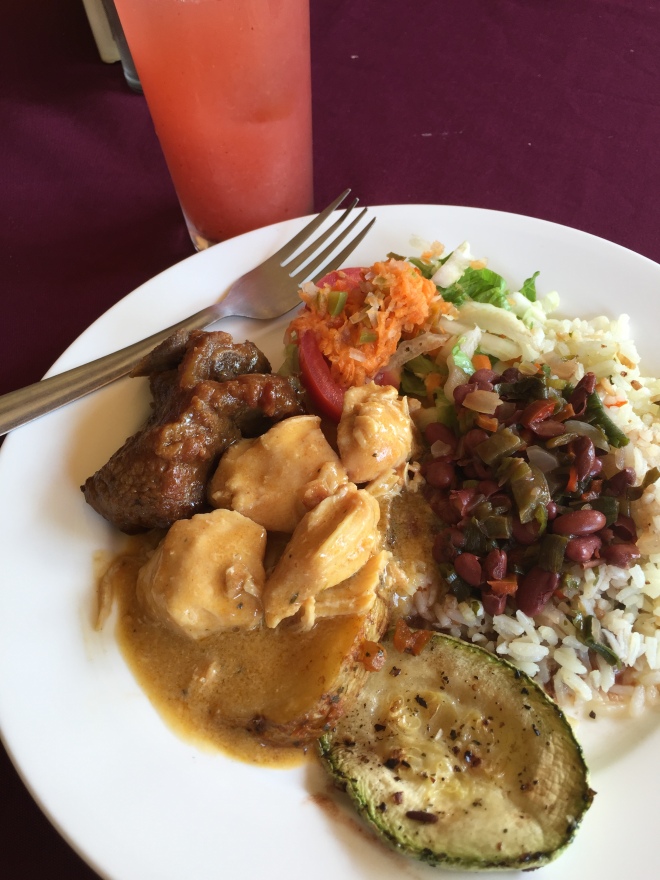
Lunch at Doka Estate - Chicken in curry, beef ribs, rice and red beans sauce, salad, veggies.

Lunch at Doka Estate – Chicken in curry, beef ribs, rice and red beans sauce, salad, veggies.

The lush garden at Doka Estate
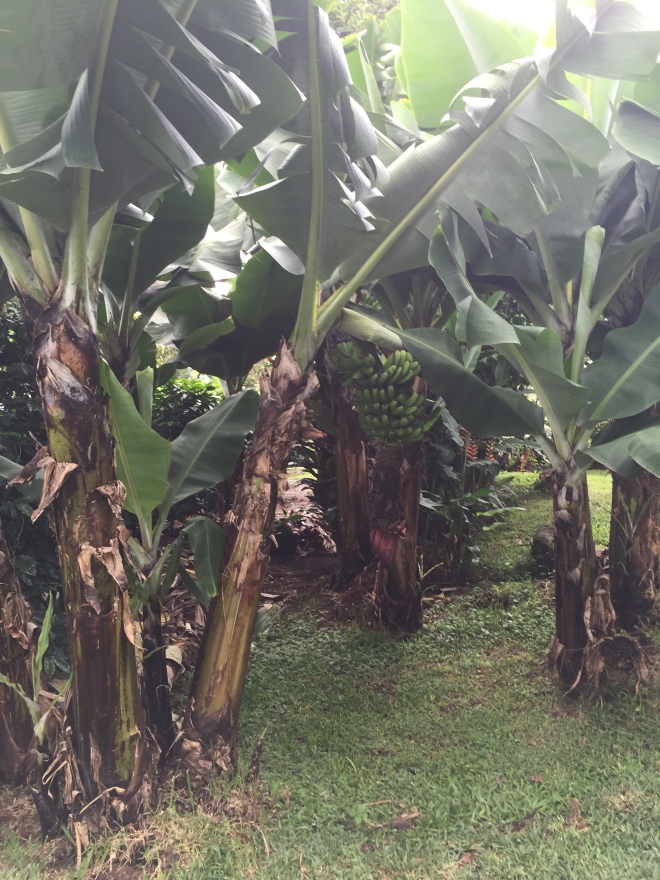
The lush garden at Doka Estate

Banana trees to distract insects from eating the coffee beans

Banana trees to distract insects from eating the coffee beans

Do you ever wonder why coffee is so expensive? Well, after I recently visited a coffee plantation called Doka Estate, in
Costa Rica, I can totally understand why the prices are so high. It’s a long process to get from the coffee bean to the cup. I will share with you my experience, and what I learned from the tour guide. It starts out with the coffee beans from the berries, that are planted, and grown in different stages. Eventually, they are transplanted in the coffee fields, where they take about 3 years to produce the berries. The trees can live up to 100 years, however, after 25 years, the quality starts to deteriorate. The plant is called Coffea, and originated in Africa. It produces fragrant white flowers which turn into green berries. When the berries are ripe, they turn red, and are ready to be picked by hand.  They don’t all ripen at the same time, and that makes the process more tedious.  This particular plantation has about 200 pickers, and they use what is called a canasto, a basket to collect the berries. (It looks like a laundry basket) The pickers collect up to 20 baskets a day each.  Inside the berries are two coffee beans, but once in a great while, some will have just one bean, and it’s called the peaberry.

The tour begins in the seedbed, where the tour guide explains the development process of the plant, the collection of the ripe berries, the classification, the fermentation, the drying, the peeling and the roasting  process.
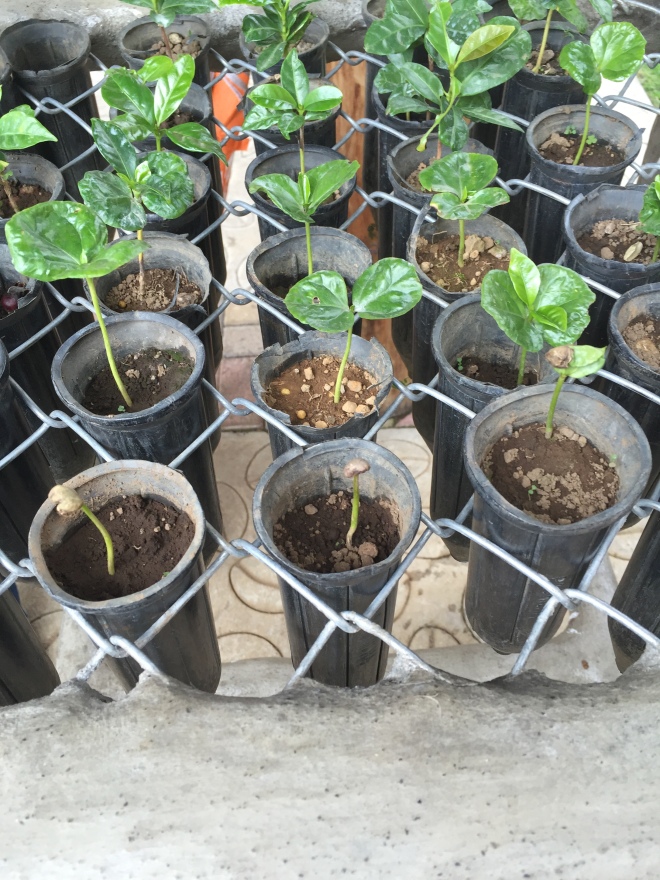
Coffee seedbed
Coffee seedbed

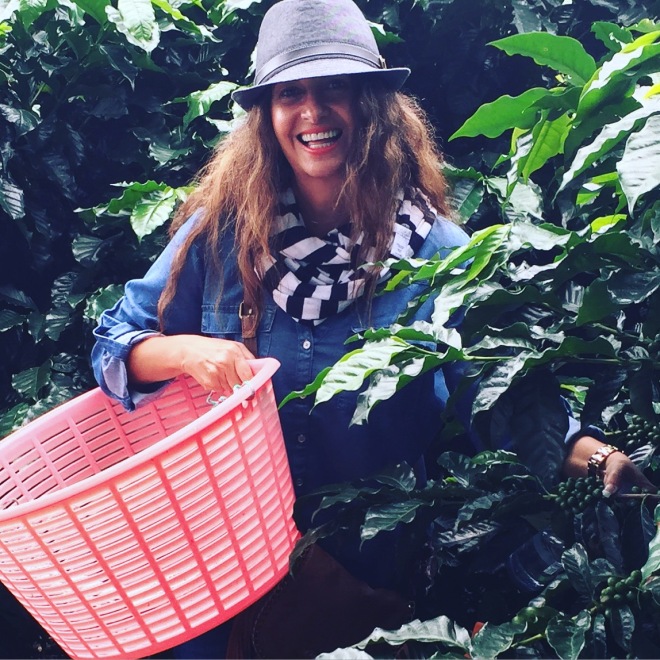
That's me,picking coffee beans off the plant using a canasto
That’s me, picking coffee beans off the plant using a canasto


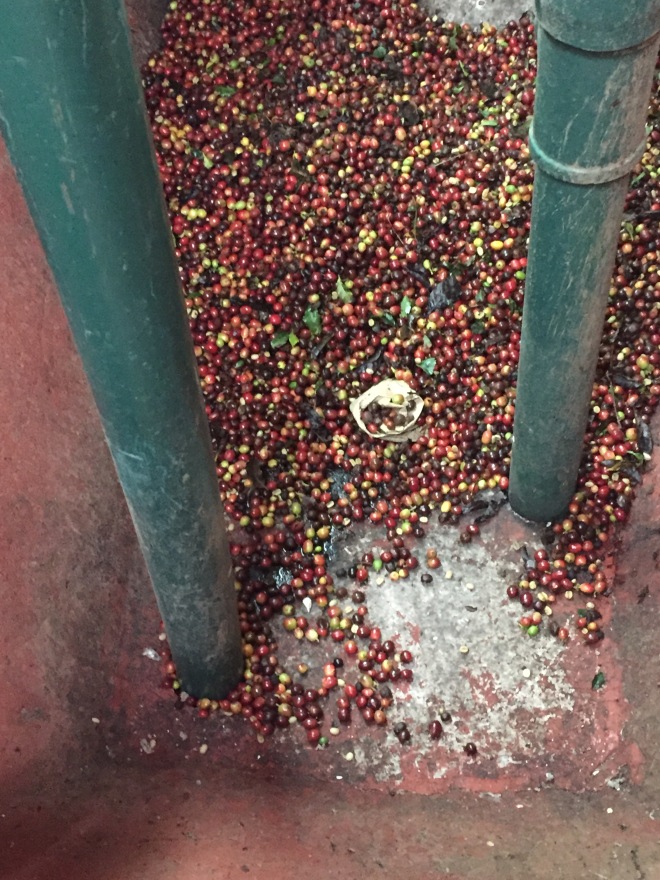
Machine collecting coffee to classify them

Machine collecting coffee to classify them

The second station is the oldest humid coffee processing plant in the country that works by hydraulic power.  The grains are classified, and the best ones are heavy, and stay on the bottom.  Afterwards, the process of de-pulping of first and second quality coffee takes place in the grinders.
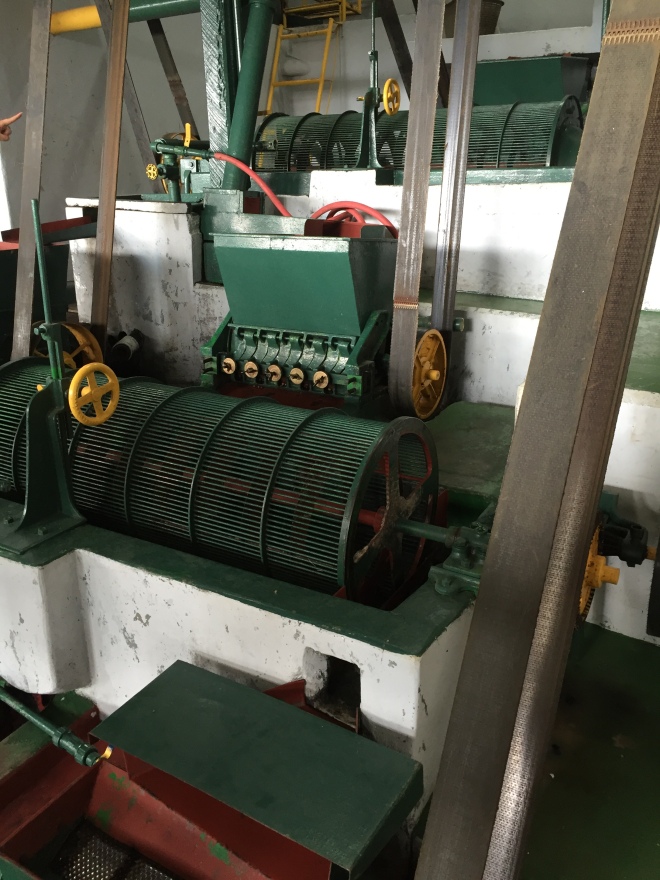
 

Sorting the coffee

Sorting the coffee

Next, the natural honey of the grain is cut in the fermentation tanks. This  process is vital, and significant to the taste of the coffee. The coffee is dried on the patios under the sun.  During rainy seasons, they use a drying machine, but they prefer the natural method.
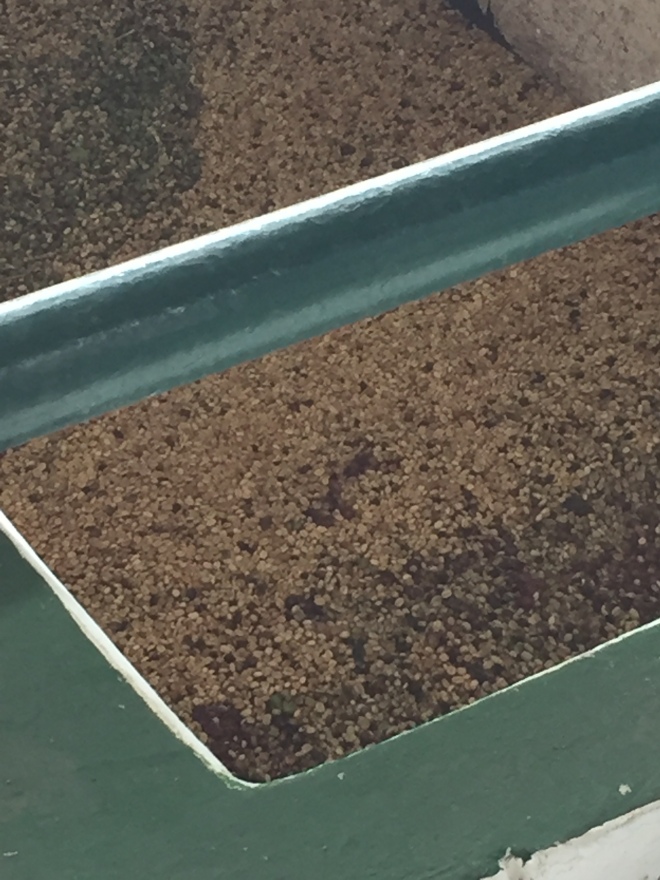
Coffee fermentation tanks

Coffee fermentation tanks

Coffee drying machine
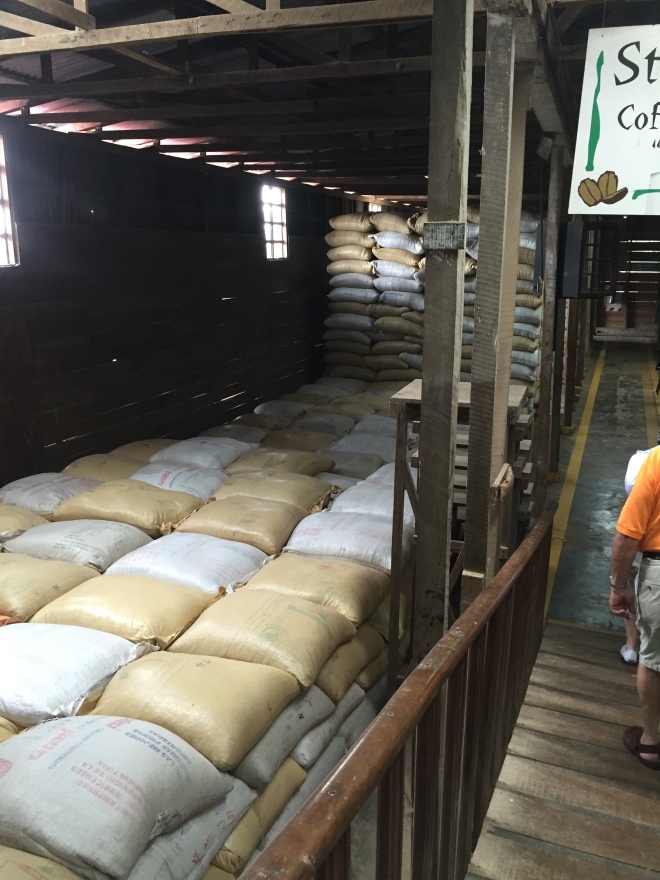
Coffee drying machine


Dried coffee is stored for 3 months

Dried coffee is stored for 3 months

Afterwards, the coffee beans are stored in the warehouse for three months in their parchment, the outer layer of the coffee beans.
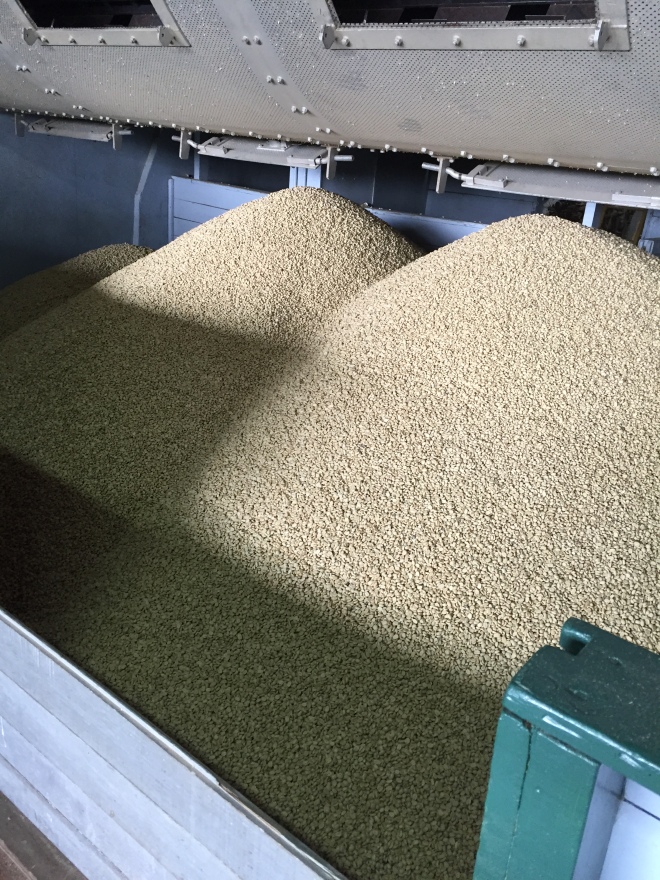
Coffee after it's dried

Coffee after it’s dried

At this point, the coffee still has no fragrance, but they are ready to be peeled, and then exported or roasted in the country. The parchment is used to make paper.

A very small portion is used to make decaffeinated coffee. They get shipped to Germany to remove the caffeine from the coffee beans. They do not have the machines in Costa Rica because most people drink regular coffee, and the machinery is quite expensive.  Why Germany, you might ask? It’s simple, they have the engineering, and they use water only without any chemicals  in this process. They don’t charge Doka Estate for this service.  Germany sells the caffeine that has been removed from the coffee beans to large companies such as Coca Cola, Red Bull, etc., that’s how they profit from this service.

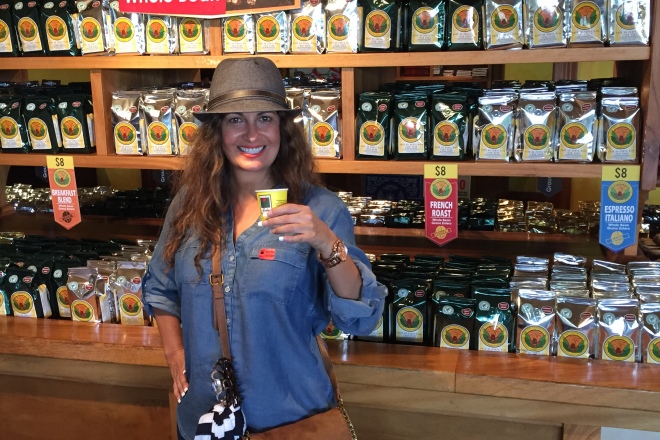
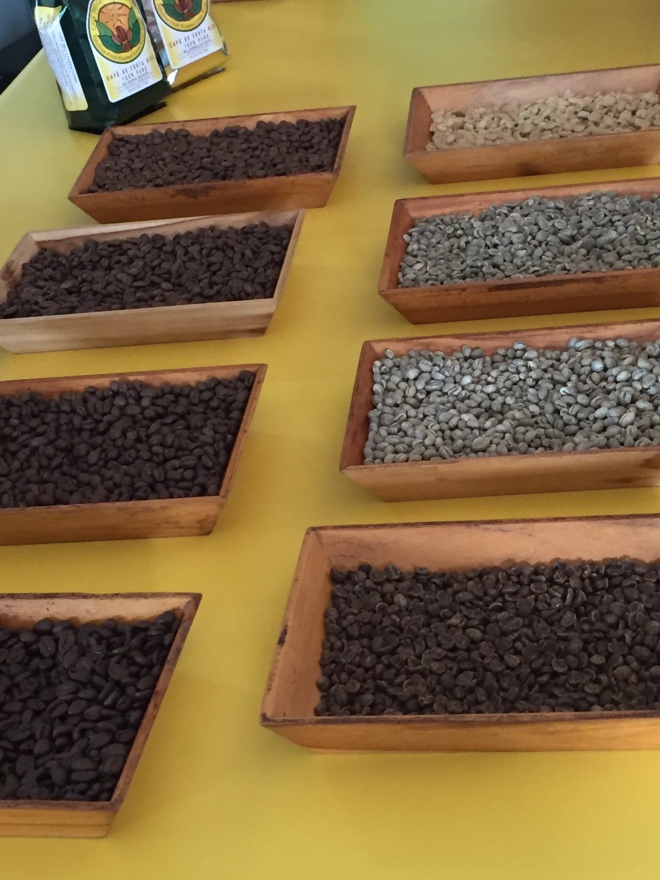
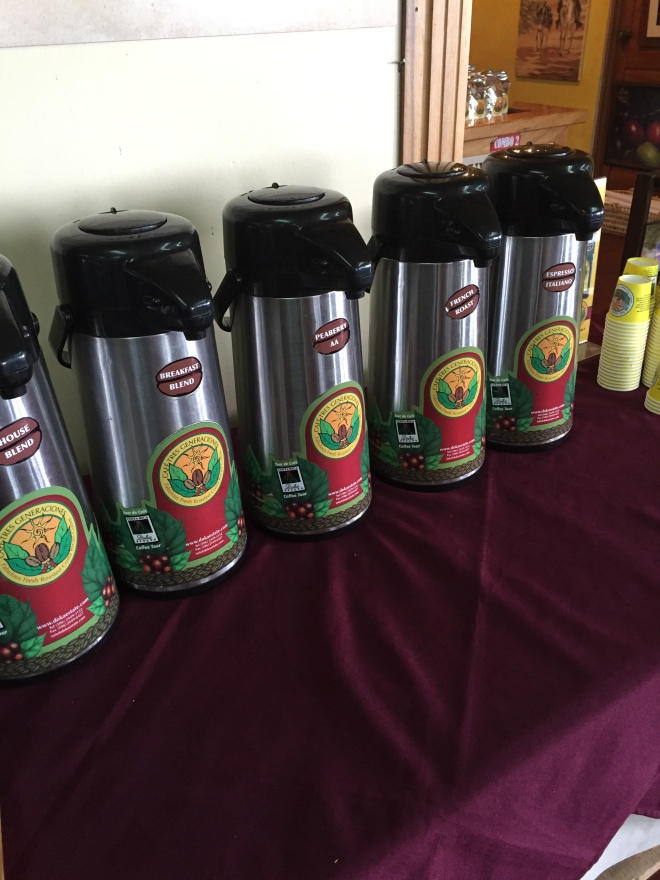
Finally, the roasting plant is visited,  and we observe the different types of roasts: Italian Espresso is roasted for 20 minutes, Peaberry is roasted for 18 minutes, and French Roast is roasted for 15 minutes. The longer it is roasted, the more intense the flavor.  This explains why the espresso is the strongest.
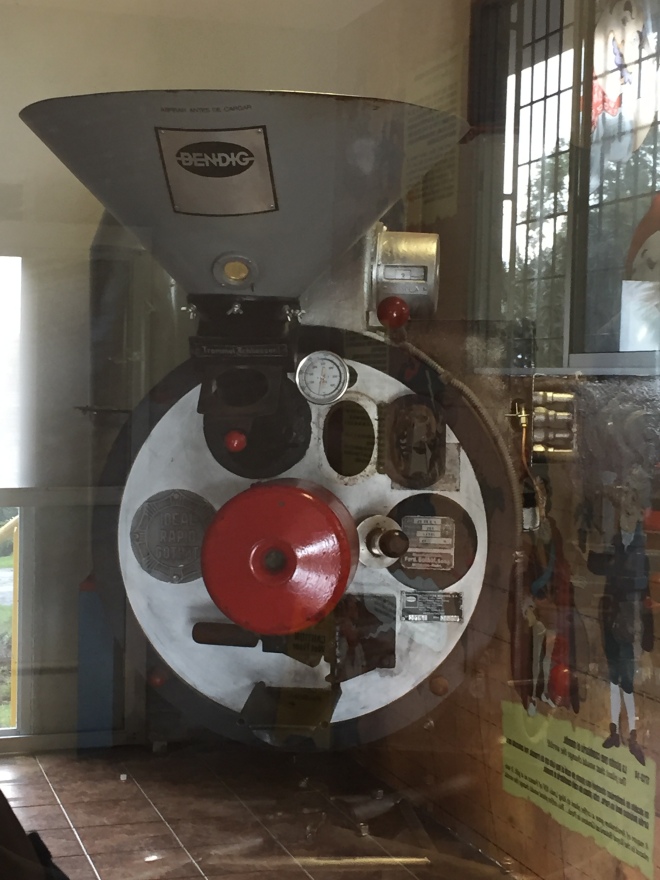
Coffee roasting machine
Coffee roasting machine

Different types of roasted coffee
Different types of roasted coffee

Coffee tasting
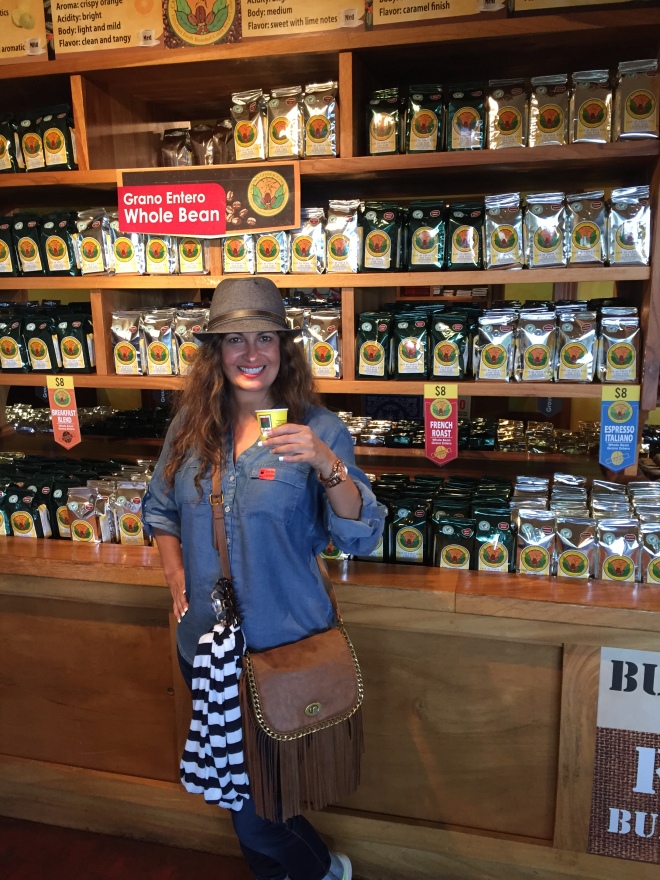
Coffee tasting

Coffee sampling

Coffee sampling


“Doka Estate coffee is one of Costa Rica’s highest quality coffees. The Doka Coffee Estate is located on the fertile slopes of the Alajuela Poas Volcano, the rich soil and the ideal altitude and climate have made the Santa Eduviges farm famous because of its excellent coffee.

The Vargas coffee growing family also carry a brand – Cafe Tres Generaciones – ‘Three Generations Coffee’ that conveys the great care and pride that this coffee growing family have placed in their coffee trees.”

Pictures:  by Foodiewinelover –  taken with my iPhone 6
Source: Information was obtained from the tour guide Adriana, my observations, and Doka Estate website.

I hope you have enjoyed, and learned some interesting facts about my journey through the coffee-making process.

Happy Coffee Sipping!

Gina, Foodiewinelover

Foodiewinelover

Foodiewinelover


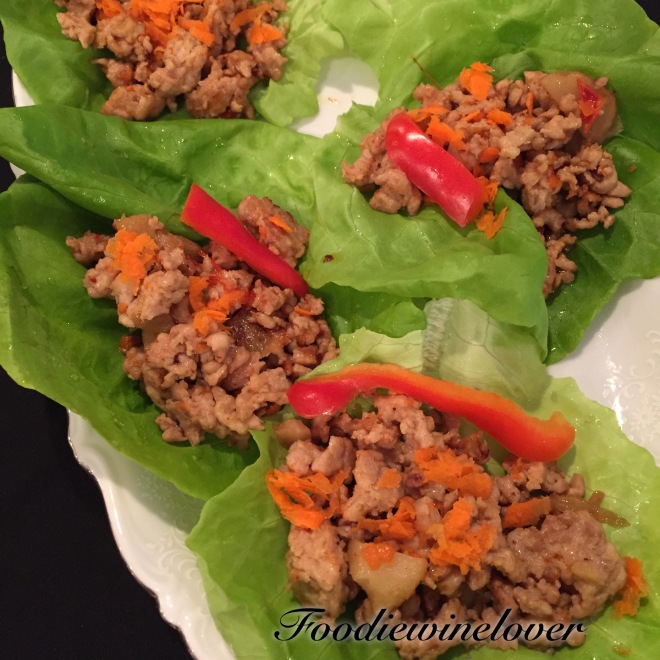
Chicken Lettuce Wraps

With today’s busy lives, people are pressed for time, and need quick and easy recipes for weeknight meals. These Chicken Lettuce Wraps take no time, and are delightful. This is my creation, and I am happy to share my passion in the kitchen with all of you.

Serves: 4   Degree of difficulty: Easy

Chicken Lettuce Wraps

Ingredients:

  •  3 tbsp. sesame oil
  • 1/4 cup onions, chopped
  • 1/4 cup red bell peppers, chopped
  • 1/4 cup canned water chestnut, chopped
  • 3 garlic cloves, chopped
  • 1 tsp. fresh ginger, grated
  • 2 lbs ground chicken
  • 1.5 – 2 tbsp. Soy sauce, low sodium
  • Dash of Cayenne pepper
  • 1/2 cup carrots, grated, + more for garnish
  • Salt, optional
  • 1 head of bib, or butter lettuce leavesPreparation:  
  1. In a large skillet or wok, over medium-high heat, heat oil, add onions, peppers, water chestnut, garlic, ginger. Saute’ for 5 -6 minutes, stir occasionally.
  2. Add chicken, stir fry for 5 minutes. Add soy sauce, Cayenne pepper, carrots, salt, fry  while stirring for another 5-7 minutes, or until chicken is cooked through. (Do not attempt to taste unless you are certain chicken is cooked, and has an opaque color)
  3. Fill the lettuce with the chicken and serve with a peanut, soy or any sauce of your choice. Serve with brown or white rice on the side for a complete meal. Try this easy and delicious meal, and your family will appreciate your love for them, through your cooking.
    Chicken Lettuce Wraps

    Chicken Lettuce Wraps

    Happy Stir Frying from My Kitchen to Yours!

    Gina 
    Super-High-Res-with-White-BG

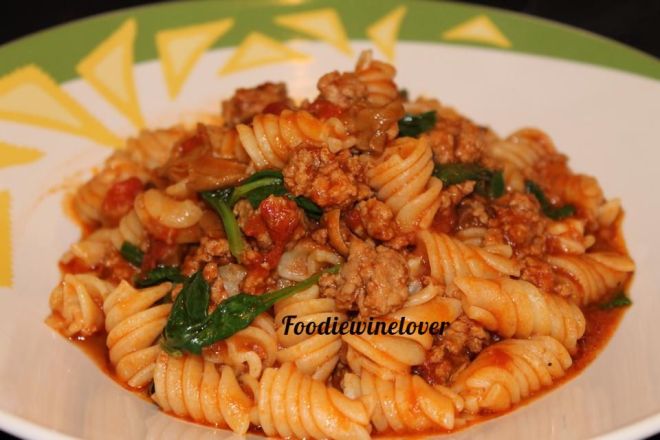
Rustic Style Pasta with Veal, Porcini Mushrooms and Spinach

This flavorful dish is inspired by the mountainous region of Abruzzo, where you will find an abundance of porcini mushrooms. The original recipe was developed by an Italian chef but I put my own spin on it and tweaked the measurements. I have followed his method, and prepared it many times in my kitchen. He recommends using Farfalle, a pasta shape, commonly known as bow-ties, but it literally means “butterflies” in Italian.  You can also use Fusilli, a short pasta shaped like a corkscrew. They both work well, and absorb the sauce nicely.  It’s always a big hit in my kitchen, and perfect for feeding a small crowd.  This recipe brilliantly combines veal, beef, and pork, tomato paste, and porcini mushrooms to create a culinary masterpiece. Make sure you caramelize the tomato paste to get a rust color, and the result will be a stupendous rustic dish packed with layers of deep flavors. Make it for a dinner party, and your guests will think that the sauce has simmered for hours.

Serves 8 to 10 as a first course, 6 as a main
Level of difficulty – medium

Ingredients: 

6 ounces dried porcini mushrooms, soaked in 2 cups hot water for 10 minutes

¼ cup extra virgin olive oil

4 garlic cloves, thinly sliced

2- 2.5 pounds ground veal, beef, and pork divided equally

Salt and freshly ground black pepper

1/2 cup tomato paste

1 cup dry white wine

1 cup plain tomato sauce

14 oz. whole San Marzano tomatoes, crushed by hand

1/4- 1/2 cup reserve pasta water

1 pound farfalle pasta

1 handful of salt for the pasta water

6-8 ounces baby spinach, trimmed

½ cup freshly grated Pecorino Romano

Preparation: 

1. Drain the porcini, reserving the soaking liquid, and coarsely chop the porcini. Strain the soaking liquid through a strainer, and set it aside.

2. In a large skillet, heat the olive oil over medium-high heat. Add the garlic and cook until it is lightly toasted. Add all the meat and the chopped porcini, and cook, stirring, over medium-high heat until the meat is well browned, about 10 minutes. Season with salt and pepper to taste, and add the tomato paste. Cook over high heat, stirring constantly, until the paste turns a rust color, 5 minutes. Add the wine and the strained porcini soaking liquid, and cook for 5 minutes, until the wine has almost completely evaporated. Add the tomato sauce and crushed tomatoes. Reduce the heat to a very low simmer.

3. Bring pasta water to a boil. Add salt. Cook according to package directions or al dente. Drain, and add  the reserve water into the meat mixture. Stir in the baby spinach and mix well until the pasta is nicely coated. Pour into a serving bowl and serve at once, with the grated Pecorino on the side.

My wine suggestion: Montepulciano d’Abruzzo, a delightful red wine from the Abruzzo region of Italy.

Rustic Style Pasta with Veal, Porcini Mushrooms and Spinach

Rustic Style Pasta with Veal, Porcini Mushrooms and Spinach

Butternut Squash, Fall Soup Challenge

Butternut Squash – Source: Wikipedia

Butternut Squash

I belong to a wonderful group of food bloggers on Facebook called Foodify, and I am one of the proud admins.  Occasionally, we feature an event, challenging our members with a recipe contest. The most recent event is called: The Fall Soup Challenge.  The recipe must include a seasonal veggie, and/or legumes, and must not exceed 6 ingredients, excluding salt & pepper.  I picked butternut squash, because the color reflects the wonderful hues associated with the fall season, and l love the rich flavors. I wanted to add onions, but I would have had to use oil, and that would have put me over the limit. Here is a recipe that I created in my kitchen, and I am happy to share it with all of you. As the members post their recipes on our Facebook Event Page, I will be sharing their blog links on here. Please check back, as I will be updating from time to time, to include every participant.

Serves: 3-4  Level of difficulty: Easy – medium

Ingredients:

  • 4 cups butternut squash, cubed
  • 3.5 cups water *
  • 1 sage leaf, + more for garnish
  • Nutmeg, 10-12 grates + more for garnish
  • Salt & pepper
  • 1/4 cup heavy cream, optional
    Preparation:

    1) Place the butternut squash and water in a medium-sized pot. Over medium-high heat, bring to a boil, cook for 5 minutes or until tender.

    2)  With a large slotted spoon, pick the butternut squash (leaving the water in the pot) and put in a  food processor. Pulse it until it’s pureed.

    3) (if you were sautéing onions, this would be the time to do it, in a small frying pan)  Place the butternut squash purée back in the pot, add 1 sage leaf, nutmeg, salt & pepper and simmer for at least 15 minutes, stirring occasionally.

    4) Slowly add the cream, stir, and cook for an additional 5 minutes. Garnish with sage leaves, and nutmeg.  Serve in a soup bowl.

    This was a lovely side to a Turkey, Brie and Green Apple Sandwich that I also prepared that evening.

    * You can substitute the water with a low sodium chicken or vegetable broth for added richness.

    Butternut Squash Soup
    Foodify Fall Food Challenge Participants:  

    Roasted Carrot Saffron Soup  From Kicking back the Pebbles

    Vegetarian Coconut Pumpkin Curry Soup by Kouzounas Kitchen

    Thai Flavored Lentil and Squash Soup by Crackle and Temper

    Beet Soup with Veggie Chips by Art and Kitchen

    I hope you will attempt to make these delicious fall soups, and share your experience with us.  Happy Cooking From My Kitchen to Yours!

    Gina ~ Foodiewinelover

    Super-High-Res-with-White-BG

Perfectly Broiled Butternut Squash

Tis The Season for Butternut Squash! Everyone, including myself, always strive to get the perfect color on roasted butternut squash. I always bake them, but I am never fully satisfied the way they come out. I decided to broil them, and the result was magical. I ran out quickly, and left my son Peter-John in charge. He took over the kitchen, and turned them occasionally.  Upon returning home, they were already on the serving dish draining on paper towels.  I could not believe how beautiful and colorful they looked in such a short period. If you love your veggies, this delicious and nutritious side dish is for you.

Serves: 3-4  Degree of difficulty: Easy
butternut-squash

Ingredients:

  • 1 lb. of butternut squash, cubed
  •  Sea salt, and freshly ground pepper, to taste
  • 2- 3 sprigs of fresh thyme, de-stemmed, + more for garnish
  • Extra virgin olive oil to drizzle

Preparation:

  1. Place the oven shelf about 11 inches away from the burner.  Turn the broiler on high.

2. In the meantime, on a flat metal tray, scatter the butternut squash cubes in a single layer. Season with salt, pepper, and thyme. Drizzle 2-3  times with olive oil. I use an oil bottle spout to give me more control.

3. Place the tray with butternut squash  in the broiler.  The trick is to turn them occasionally, using a metal spatula (it doesn’t have to be one by one) for about 10 minutes , or until they obtain a golden brown color. Remove from the oven.

4.  Layer the bottom of a serving dish with some paper towels to soak up any excess oil, and plate the butternut squash. This step will prevent them from becoming soggy. Serve immediately. This was a lovely accompaniment to a red grouper, but it was so good, that it barely made it to the table.

image

I hope you will try this recipe in your kitchen, and share your experience with us. Happy Cooking from My Kitchen to Yours!

Gina Martino Zarcadoolas, aka Foodiewinelover
Culinary Personality, Food & Wine Blogger
Author of the cookbook: Cuisines, Corkscrews & Cultures
Level-2 Certified world-renowned – “WSET: Wine, Spirit, Education, Trust”
Level-2 Certified Sommelier
Winner of 2019 “Salice Salentino USA Bloggers” Award
Exclusive photos by Gina Martino Zarcadoolas
All rights reserved.

Foodiewinelover


Heavenly Cheeses, Food & Wine Pairings

Hello everyone! This is probably my longest blog post to date, because it is my favorite, and most passionate subject,  Food & Wine. This explains my blog name, Foodiewinelover.  I have put together a compilation of my dining and wining experience on Heavenly Cheeses, Food & Wine Pairings.  Please do not forget to read the descriptions on all my photos.  Cheeses are among my favorite food groups, and when I’m entertaining, I love pairing them with delicious wines. There is an abundance of cheeses, and wines from all corners of the world, but unfortunately, there aren’t enough time to mention all of them.   Ideally, I love pairing cheese with the wine from the same region, or country, especially when I’m having a themed party. However,  there are no set rules about it, and, you can mix and match food and wines from different countries, as you please. There are hard, soft, and semi-soft cheeses. One of my favorite cheeses is Parmigiano-Reggiano, an Italian Parmesan cheese, aged 36 months, that I brought back with me from Italy. To me it’s considered the king of Italian cheeses, and has a lovely nuttiness to it.  According to Giada de Laurentiis, a famous Italian Chef, it’s best if you pick it with a knife, to get into all the nook and crannies, for optimal flavors.  In general, white wine is ideal to pair with cheeses because of their higher acidity content, and boost up the layers of flavors of cheeses. However, If you are not a big fan of whites, don’t fret, red wines  also make a nice pairing. Ultimately, you decide what works well with your palate. I am also sharing with you some delectable food that goes with some interesting wines.  Here are a few suggestions to impress your friends at your next gathering.

Guidalberto paired with Parmigiano Reggiano

Sexy, seductive, full-bodied, Super Tuscan, Italian wine, blend of Cabernet and Merlot – 2012 Tenuta SanGuido – Guidalberto . The color is a scintillating cherry-red. At first, floral aromas and dark cherries on the nose, then, when I swirl it, the earthiness comes out. I smell barnyard and chocolate. I swoosh it in my mouth, I get hints of tobacco, chocolate, leather, and all the flavor profile I desire in a wine. The finish is succulent and lingering. This wine pairs heavenly with Parmigiano Reggiano.

Cheese and wine pairing

Great cheese and wine pairings: Pulenta Cab from Argentina, Robert Mondavi, Emblem California Cab, & a platter of barrel aged Feta, Ginger and Mango Stilton, Pecorino Romano cheese.

Epoisse

Wine & Cheese for Dinner! Époisses, the stinkiest cheese ever. Lol! Prima Donna, a blend of Parmigiano Reggiano and Gouda, paired with La Crema, Pinot Noir. If you prefer white, you can pair with an Albarino, or a nice Chablis, (Chardonnay from Burgundy)

Manchego and Crianza

Manchego cheese paired magically with Miguel Torres Celeste Crianza, from the Ribera del Duero region of Spain. A beautiful pairing of cheese and wine from the same country.

Malbecandcheesepairing

Girls Night Out! Malbec paired with scrumptious Comte, Idiazabal and Ossau Iraty cheeses. 🍷🍷🍷

MerlotandHumboldtFog

Merlot and Humboldt Fog cheese….Pinot Noir would have been a nice choice as well

BrunellowithDeliceDeBourgogne

Le Delice De Bourgogne cheese paired with a fantastic Brunello.  If you are into white wines, another suggestion for this cheese is an oaky Chardonnay 


Foodiewinelover Stonecrabs

Stonecrabs paired with Champagne for my birthday in 2014


Foodiewinelover Bubblies

When in doubt, bubblies go with almost everything


Espinacas y Garbanzos

Spinach and Garbanzos, paired with a lovely white Rioja

Bai Gorri Rioja

Bai Gorri Rioja, An elegant white wine, well-balanced with intense flavors of oak, paired heavenly with an assortment of Spanish dishes, Shrimp with Garlic, Spinach with Garbanzo beans, Paella, and Manchego cheese. This was at our Spanish-themed wine party.


Lamb Loin Chops

Lamb Loin Chops pair beautifully with Chateau-Neuf-du-Pape or a nice red Bordeaux


Paella

Paella pairs deliciously with a nice Rose’

Rose' pairs nicely with a Paella

Rose’


Beets and Goat Cheese

Beets and Goat Cheese pair lusciously with a crisp Sauvignon Blanc

Gouda and Epoisses cheeses paired with Merlot

Gouda and Epoisses cheeses, caramelized walnuts and fig spread, paired exquisitely with Chateau Lyonnat, a Merlot from the Bordeaux region. Delicieux!

Veal Bolognese

Veal Bolognese over Pappardelle, paired nicely with a Rosso di Montalcino

Porterhouse for two paired with a Super Tuscan

Aged Porterhouse for two paired scrumptiously with a Super Tuscan

If you are a salmon lover, pick a lush Pinot Noir from Oregon, or one from the Russian River Valley, Sonoma county, California.  They both would make great choices. For any white fish, select a crisp white wine, if you want to get fancy, try a delightful Sancerre, (Sauvignon Blanc) from the Loire Valley.  If you are on a budget, stick to a nice chilled chardonnay.  Spicy food pair well with an off-dry Riesling, Viognier or Gewurztraminer. Pungent cheeses such as Gorgonzola, or Blue Cheese stand up to dessert wines, port or cognac. Sauternes, a French dessert wine, with notes of apricots,  is a nice complement to Roquefort cheese and Foie Gras. Let’s not forget about Ricotta cheese which is used in savory dishes such as stuffed shells. They make a great pairing with a nice Chianti, Rosso di Montalcino, or any medium-bodied Italian reds.  Ricotta cheese is also used as a scrumptious filling in cannolis, and goes well with a Moscato d’Asti, a lovely dessert wine from the Piedmont region of Italy.  If you are looking for a match made in heaven,  my friend, fellow-sommelier, Certified Italian Wine Specialist, Angela, from Constant Wining suggests pairing a cantuccini, an Italian biscotti, with Vin Santo. We had it at one of our Italian-themed wine party, and it was a major hit, and a fantastic way to end a superb evening with fun friends. Mascarpone, is an italian sweet cheese, and one of the main ingredients in the delectable dessert Tiramisu. It can be paired with either the Vin Santo, or the Moscato d’Asti.

I am posting links to some of the cheeses that I feature in this blogpost,  so you can learn more about their process, origin, and history.

Parmigiano Reggiano and Pecorino Romano, two Italian giants, are excellent grating cheeses for pasta dishes.  Gorgonzola,  Blue Stilton, Roquefort,  are considered some of the world’s most famous Bleu Cheeses. Feta Cheese is one of the most famous Greek cheeses. Humboldt Fog, is a goat milk and pungent in flavors. Epoisses is a pungent cows-milk cheese.  Delice de Bourgogne, is a French cow’s milk cheese. Manchego is a sheep’s milk from Spain. Comté is a cow’s milk from France. Ossau Iraty is a sheep’s cheese from France.  Idiazabal is a sheep’s milk from Spain.

I hope you have enjoyed some of my food and wine suggestions, and in closing, I would love to share some fun quotes with you.

“All four elements were happening in equal measure – the cuisine, the wine, the service, and the overall ambience. It taught me that dining could happen at a spiritual level.” Charlie Trotter

“Wine to me is passion. It’s family and friends. It’s warmth of heart and generosity of spirit. Wine is art. It’s culture. It’s the essence of civilization and the art of living.” Robert Mondavi

Most importantly, I enjoy sharing food & wine with close friends, and family. It elevates the experience to another level.

Disclosure: All the pictures in this blog post are my own, and were taken either with my iPhone or my Canon Rebel T3 camera.  They were shot at various restaurants, a friend’s house, and my home.

Cheers to good health and a well-lived life!

Gina, aka, FoodieWineLover 


1 7 8 9 16