Puglia has become one of the hottest spots in Italy where people flock to the beach to bask in the hot sun, enjoy the local wines, and partake in the Italian culinary traditions. This region is known for its wine production, cultivation of tomatoes and artichokes, and is a major producer of olive oil. It’s also known for its famous “cucina povera” which translates to poor cuisine because the people use simple, seasonal, and high-quality ingredients. Orecchiette—Italian for “little ears”— a regional pasta shape, fava beans, eggplant, and an abundance of fresh seafood are part of their diet. The Puglian cuisine and the wines produced in this area intertwined nicely.
As a result of my infinite love affair with Italian wines, I have tasted hundreds of them in classes, seminars, festivals, and private gatherings. If you are a wine enthusiast like me, you would be constantly exploring grape varieties from different Italian regions.
In this article, I will focus on Salice Salentino DOC wines from the Salento area. They deserve to be recognized for their richness and signature taste. Their production is still in its infancy stage unlike the wines from other major Italian regions like Piedmont and Tuscany.
Facts and history:
The Salento Peninsula in the region of Puglia is in the southernmost part of the boot known as the heel. It is bordered by the Adriatic and Ionian Seas with a sunny dry climate. The soil is fertile and the wines tend to be high in alcohol. This is due to the lack of rain in the area which creates a challenge for winemakers to craft attractive wines. The Salento area is renowned for its beautiful landscape, exquisite regional cuisine,
sun-baked vineyards, luscious wines, and cultural diversity.
In the 1930s, the farmers would combine the Negroamaro grape, known for its earthy bitterness with the Malvasia Nera to add sweet character to the wine. This blend created a perfectly balanced wine. The rosé version followed soon after. Over time, the farmers continued to experiment and created new varieties of Salice Salentino, which now include: Negroamaro, Negroamaro Rosato, (rosé) Pinot Bianco (white wine), Fiano, Chardonnay, and Aleatico.
The Salice Salentino wines became so important in that region, that, in 1976, they were assigned the DOP: “Denominazione di Origine controllata –official quality label (DOC, “controlled designation of origin”.)
Salice Salentino owes its name to the town bearing the same name in the province of Lecce. This province is known for beautiful churches and baroque-style architecture. Lecce has been the main production of these wines for years, and is protected by a Consortium called: Consorzio Di Tutela Vini D.O.P. Salice Salentino. The Consortium was founded in 2003 and consist of 1,858 members, among them are winemakers, bottlers, and winegrowers. The goal is to promote and ensure the protection of the territories, vineyards, ancient trees, and the indigenous grapes of the provinces of Lecce and Brindisi. The wines from that region are marketed and controlled by the Consortium to ensure the quality and the authenticity of the local grapes. Additionally, it was created to enhance and preserve this area for its great winemaking tradition.
The main grape is the Negroamaro, which translates to “black bitter” in Italian. This grape variety thrives on the terroir that combines clay and limestone soils. The Malvasia Nera is also a popular variety known for its aromatic qualities. Both grapes tend to be dark and intense in flavors.
Production and procedural guidelines:
For many years, the Salice Salentino wines have been made according to the requirements of their procedural guidelines. The entire process, from the grape growing to the final stage must take place in a specific area. It includes the districts of Salice Salentino, Veglie and Guagnano, in the province of Lecce, and Sandonaci, in the province of Brindisi, as well as some portions of the districts of Cellino San Marco (Lecce) and Campi Salentina (Brindisi).
Specific grapes are required for each single Salice Salentino wine.
At least 75% of Negroamaro grapes is required in the Salice Salentino Rosso (red) and the Rosato (rosé wines); whereas 90% of Negroamaro is required in the Salice Salentino Negroamaro and Negroamaro Rosato varieties. Additionally, local dark-colored grapes like the famous Malvasia Nera of Lecce or Brindisi can be used for blending as mentioned in the fifth paragraph.
In the Salentino Aleatico wine, (red) at least 85% of the Aleatico grapes is required, and can be blended with Negroamaro, Malvasia Nera or local Primitivo.
The Salice Salentino Bianco (white) is made 70% from Chardonnay grapes, if it does not have any other appellation. There are other types of Salice Salentino Bianco—Chardonnay, Fiano and Pinot Bianco which must contain at least 85% of the corresponding grapes.
There are also Spumante (sparkling wine) versions of the Salice Salentino on the market. This method involves natural fermentation without the addition of carbon dioxide. The Bianco, Rosato, Negroamaro Rosato, Pinot Bianco, Fiano and Chardonnay are generally used for this style of wine.
The Riserva (reserve) versions of Salice Salentino Rosso, Negroamaro, and Aleatico are aged for at least 24 months, including at least 6 in oak barrels.
The Dolce and Liquoroso versions of the Salice Salentino Aleatico are also produced and make great dessert wines. The Dolce Naturale must have a finished alcohol of 15% and Liquoroso must have 18.5% which is like a fortified wine. Once produced, the wine is bottled in glass bottles that can have different sizes and corks, depending on the type of product.
Flavors and characteristics:
These Salice Salentino wines are enjoyed worldwide. The red ones are generally cherry, ruby or garnet-colored, and their shades become more intense as they age. The Riserva tends to have a brick color. The red wines are robust and full-bodied and can generally be classified as dry wines. The Rosso Riserva and Rosso Riserva Negroamaro have fragrant aromas of ripe fruits such as plums and cherries with a touch of spices. The sensory experience as perceived by sight, smell, and taste varies depending on the grape variety that has been used, and the way the wines are produced.
The Aleatico Dolce and Liquoroso Dolce varieties are predominantly sweet, dense, and are higher in alcohol.
The wines from the white grapes are straw yellow in color, refreshing, and fragrant with delicate fruit notes; while the Bianco and Fiano varieties have greenish hues.
Lastly, in the spumanti made from traditional wines, yeast notes are easily detected due to the re-fermentation process.
Food & wine pairings:
In general, meat-based recipes, and complex dishes are paired with the Salice Salentino from red grapes to stand up to the robustness of the wine. Pecorino cheese made from sheep’s milk also makes for a killer pairing. The Salice Salentino Rosato pairs nicely with salamis, less-intense dishes like chicken and pork, delicate cheeses, and fragrant frittatas.
The Salice Salentino Bianco goes well with swordfish and salmon, as well as a variety of seafood dishes. The bianco variety also pairs nicely with a Caprese salad using tomatoes and extra-virgin olive oil from the local farms. Whenever possible, pairing food and wine from the same region is ideal, as they are grown in similar soil.
The Aleatico Dolce and Liquoroso Dolce varieties make great dessert wines and would pair heavenly with the popular pasticciotto. This traditional dessert is known for its a flakiness, buttery short crust filled with an exquisitely rich vanilla pastry cream. There are also chocolate and pistachio versions of the filling. This dessert is also common for breakfast.
My food & wine pairing experience:
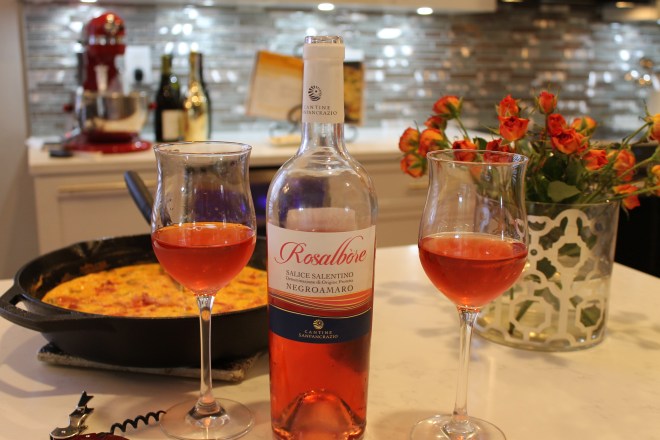
I had the pleasure of tasting the Rosalbore Salice Salentino Negroamaro Rosato DOP from Cantina Sanpancrazio, a beautiful rosé made with 100% Negroamaro grapes. The color is deep coral, (like I’ve never seen before) lightly perfumed with aromas of strawberries and gentle floral notes. The palate follows the nose, with luscious flavors of semi-ripe strawberries, and the tannins are soft. This wine is intense and well-structured with a lingering finish. The alcohol content is 13.50% by volume. The Salice Salentino Rosato represents a middle ground between the heaviness of the Rosso (red wine) and the freshness of the Bianco (white variety).

Salice Salentino Negroamaro Rosato paired with frittata

Salice Salentino Negroamaro Rosato
I paired this delightful rosé with a delicate frittata made with tomatoes, scallions, pancetta, and Pecorino Romano cheese. It was like the king meeting its queen (the rosé) in the quest for a beautiful romance. This food and wine combination went together harmoniously and felt like a never-ending fairytale on the palate.
I also tasted the Salice Salentino Rosso Riserva DOP from Cantine De Falco which is made with 80% Negroamaro and 20% Malvasia Nera. The color is garnet, showing fragrant spices like vanilla and nutmeg on the nose, dark cherries, and plums on the palate, with nuances of cocoa, cigar box, and oak. There is a hint of sweetness in the wine that comes from the ripeness of the fruits. The tannins are velvety, and the finish is persistent. The alcohol content is 14% by volume.
In the region of Puglia, it is common to eat horse meat, and it would make perfect sense to pair this big wine with it. However, since we do not consume this type of meat in the United States, I prepared braciole, an Italian-style gourmet beef dish that is stuffed with garlic, parsley, and prosciutto and then rolled up. They were seared on medium-high heat, then simmered for a couple of hours in a rustic-style tomato sauce. The stuffed meat and the acidity in the tomatoes were a perfect match for this majestic and full-bodied wine. This dining experience was the epitome of a beautifully balanced meal.
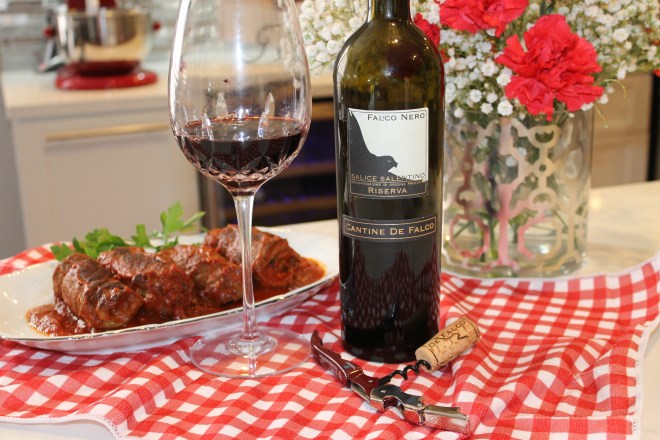
Salice Salentino Rosso Riserva DOP

Braciole
I hope this reportage on Salice Salentino wines has piqued your curiosity to explore this splendid Italian region and its autochthonous grapes. These wines are not only luscious, but they are affordable. This combination makes for a win-win sensory experience. Now, that I have tasted these wines, it’s time to visit Puglia. I will dream about it, until it becomes a reality.
Happy sipping from my kitchen to yours,
Update: I received the “Salice Salentino USA Bloggers Contest 2019” award/trophy for writing this blogpost. An all-expense paid trip was included, and the ceremony was held at Rosexpo Festival on June 22nd, 2019, in Puglia, Italy. I am excited and feel grateful to the Consortium for choosing my blogpost to represent wines from Salice Salentino. I visited this beautiful region and relished on their wines and local cuisine. I will always remember this epic moment…

Salice Salentino 2019 USA Bloggers Award
Gina Martino Zarcadoolas, aka Foodiewinelover
Culinary Personality, Food & Wine Blogger
Author of the cookbook: Cuisines, Corkscrews & Cultures
Level-2 Certified world-renowned – “WSET: Wine, Spirit, Education, Trust”
Level-2 Certified Sommelier
Winner of 2019 “Salice Salentino USA Bloggers” Award
Recognized in Lecce, Puglia, Italy on June 22, 2019
Exclusive photos by Gina Martino Zarcadoolas
All rights reserved.




 I first found out about this delicacy when I was visiting Venice in 2007 with my beautiful family. I was intrigued because I had never savored baccala that way before. Baccala is Italian for dried salted cod fish. It’s a delicious spread (dip) that originated in the region of Venice, Italy. It’s not that difficult to prepare but it can be a bit tricky. If you follow my instructions carefully, your spread will be a success just like mine. You will be using fillet (boned) code fish that’s cured in salt. It’s usually found in a plastic bag near the seafood department of your grocery store. I am certain, you can also find it in the outdoor markets without the plastic, depending what part of the world you live in. Fear not, it’s cured with lots of salt and it’s not easily perishable. If you don’t properly prepare it, you will be left with a dish that is inedible due to the high sodium content. You will need a little less than two hours from start to finish to obtain the final results. Today, I am using a food processor and not my hands, which could be a daunting task. This is the perfect appetizer for an Italian-themed party, and pairs lusciously with Prosecco or any bubbly of your choice. I promise you, if your guests like seafood, they will be impressed with your culinary skills.




 Foodie WineLover
Recent comments